Agents Are the Easy Part
AI agents will soon handle sourcing, screening and diligence, and venture firms will get flatter for it. But an agent is only as good as the platform underneath it, and that platform, not the agent, is the part you cannot buy.

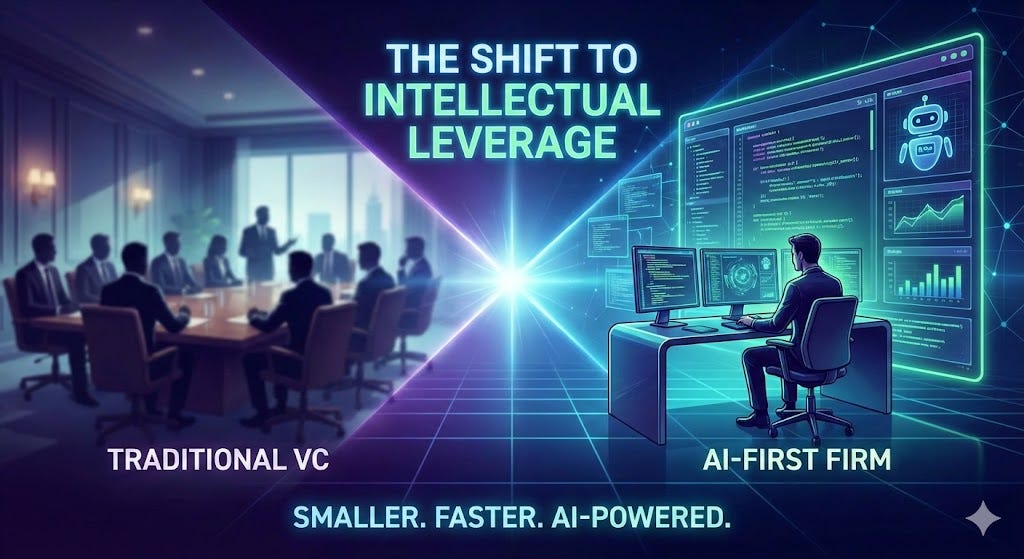
Roberto recently wrote that venture capital has become bloated, and that the next generation of firms will be small, partner-only, and powered by AI agents rather than analysts and associates. The agents, he said, will handle sourcing, screening, diligence and portfolio support, and they will not ask for carry.
I think he is right about the direction (maybe not about the carry part). What I want to add is the view from a layer down. I build the platform those agents run on, and the conclusion I keep coming back to is that the agent is the part you can buy. The platform is not.
The prediction we already made
Back in 2023 I wrote about the Platform Engineering Approach to VC: rethinking the firm across three layers, Data, Intelligence and Workflow, and treating each as something you engineer rather than something you buy. One line from that post has held up:
As LLMs become more accessible, affordable, and perform well on a wide range of zero-shot learning tasks, the challenges of the Intelligence layer shift from traditional data science (model creation and evaluation) to purely engineering and implementation tasks.
That shift has mostly happened. Three years ago the Intelligence layer meant training and evaluating models. Today a frontier model handles, zero-shot, screening tasks that used to need bespoke classifiers and proprietary labelled datasets to train them. Agents are the next step on the same line: instead of a model you call once, you have a process that plans, calls tools, reads the results, and decides what to do next. In the language of that old post, the Workflow layer is catching up to the Intelligence layer.
So where does the value sit once everyone has agents?
What does not commoditise
Everyone gets the same frontier models. A lab ships, and within a week your competitor is calling the same endpoint you are. The same goes one layer up. When people say “AI agent” today they usually mean a note-taker wired to a CRM through a handful of MCP servers, or something that reads a pitch deck and drafts a memo. That is genuinely useful, and it is also the easy part: anyone with an API key and an afternoon can wire it together.
The part that does not commoditise is what the agent reasons over.
And that is where durable advantage now lives: not in the agent, but in the data beneath it. That is the part of the stack worth investing in for the long term, because it is the part a competitor cannot buy and an API update cannot hand them. For a firm like ours, that data is specific: what we have learned about European founders and the companies they are building, the record of our own investment decisions, the calls we got right and the ones we got wrong, and the history behind many millions of startups.
The less obvious part is that better models do not erode this advantage. They widen it. A stronger model reasons more capably over the same proprietary data, so every frontier release makes a well-built data layer worth more, and the labs end up doing the R&D for whoever owns the best data. The part that compounds is the judgment no one else has. For an investor that is the passes as much as the wins: the companies we looked at and declined, the theses that did not play out. Public datasets are full of successes and silent about the rest. What you decided against, and why, is the rarest signal there is, and an agent that learns from it picks up something closer to taste than to knowledge.
What this does to the firm
Roberto’s harder claim is that agents replace not just employees but some of the general partners themselves. Seen through the platform, agents become services, and what they take on is the toil: the high-volume, repeatable tasks that never really needed judgment, only capacity.
Sourcing, first-pass screening, watching a portfolio company’s public signals, drafting the first version of a diligence memo. At a traditional firm this is work that scales with headcount, which is the reason traditional firms keep hiring. On a platform it scales with compute instead, and that is what makes the firm flatter. The judgment did not go anywhere; the platform absorbed the parts of the job that were really just throughput.
What is left for the partners is the part that does not commoditise: conviction, and the relationship with a founder who is deciding whether to let you onto their cap table. An agent can tell you that a company exists and that it fits the thesis. Deciding to believe in a founder before the market does is still a human call, and it is the one the firm is actually paid to make.
Agents are an engineering problem
None of this is push-button, and I do not want to give the impression we have it solved.
Agents drift. They hallucinate confidently. Left unsupervised, one will hand you a beautifully formatted memo built on a fact it invented in the third paragraph. What I have come to think is that this is an engineering problem more than a trust problem. What can you build around the agent to give you that trust? For us, most of that effort has gone into evaluation and continuous improvement loops using data.
This is really the platform-engineering approach again, pointed at a new kind of component: the value is less in the model than in everything around it, the evals, the guardrails, the places we keep a person in the loop, the feedback that flows back into the data.
Conclusion
And this is how we conclude that the agent on its own is the easy part. The harder part, and the part that brings lasting value, is what sits underneath and around it: the proprietary data worth reasoning over, and the unglamorous engineering that makes a capable model dependable. Neither arrives in an API update, and neither demos well. We are further along on the data than on the agents, and done with neither. Neither is the kind of thing you finish: the data ages, the models move, the checks need redoing. This is the platform engineering. The agents are the services that run on top of it.